
The appointment may be the most exciting part of an aesthetic plan, but your skin doesn’t stop needing attention once you leave the treatment room. Botox, fillers, microneedling, DiamondGlow, and Sculptra each have a specific job. What happens between appointments matters too, especially when you’re trying to keep your skin hydrated, comfortable, and looking its healthiest.
That’s where a thoughtful home routine comes in. Peptides are available in certain skincare products, but they can also be delivered through oral strips designed for absorption through the lining of the mouth. Depending on the specific peptide, these options may be explored for skin health, tissue repair, and regenerative support, although clinical evidence varies by formulation and intended use.
The goal isn’t to make a cream compete with an injectable or procedure. It’s to give your skin consistent daily care that complements the professional treatments you’ve already chosen. Keep reading to learn what peptides do in skincare, where they fit into a treatment plan, and why the products you use at home deserve just as much thought as your next appointment.
What Are Peptides in Skincare?
Before deciding whether peptides deserve a place on your bathroom shelf, it helps to understand what they actually are. The science is interesting, but the basic idea is surprisingly straightforward. Peptides are short chains of amino acids. Amino acids are the building blocks used to make proteins, including proteins associated with the skin’s structure.
You’ll find different types of peptides in skincare, and they aren’t all interchangeable. Their functions depend on their amino acid sequence, formulation, concentration, stability, and ability to interact with the skin.
Some cosmetic peptides are included in formulas designed to support the appearance of firmness, smoothness, or healthy-looking skin. Others may function differently within a formulation. That’s why seeing the word peptide on a label doesn’t tell you everything about how a product will perform.
More importantly, peptides shouldn’t be treated as topical substitutes for Botox, filler, Sculptra, or an in-office collagen-stimulating treatment. A skincare product and a medical aesthetic procedure work very differently.
The better question isn’t whether skincare can replace your treatment. It’s how the right skincare can support the skin you’re treating.
Peptides Beyond Skincare
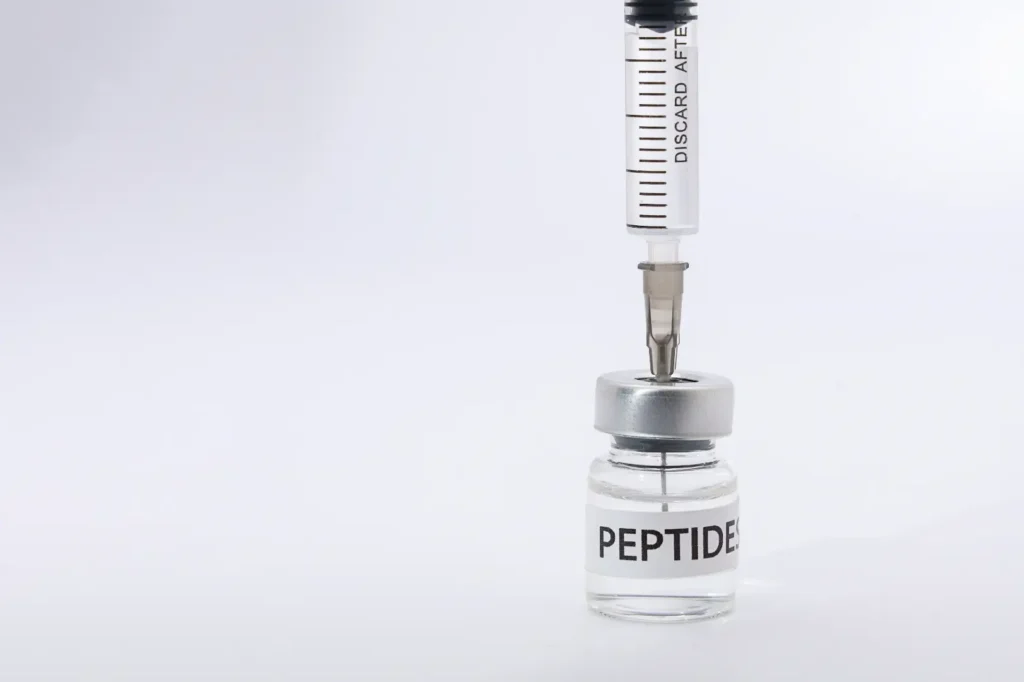
Peptides aren’t limited to creams and serums. Some formulations are available as oral strips designed to dissolve in the mouth and deliver their ingredients through the oral mucosa. This offers patients a needle-free option that may be more convenient than injectable products.
Depending on the peptide and its formulation, potential applications being studied include skin health, tissue repair, and regenerative processes. However, absorption, effectiveness, and safety vary between products.
Oral peptide strips shouldn’t automatically be considered equivalent to injectable peptides, as comparable clinical effectiveness hasn’t been established for many formulations.
Why Peptides Belong in the Bigger Plan
Your aesthetic plan doesn’t end when the appointment does. Daily skincare provides continuity between professional treatments, giving you a way to care for your skin every morning and evening.
They Support Skin’s Structural Environment
One of the most common conversations surrounding peptide ingredients in skincare involves collagen. That’s understandable because collagen is an important structural protein that contributes to the skin’s firmness and support.
Certain topical peptides are used in cosmetic formulations intended to support the skin’s extracellular matrix or improve the appearance associated with aging. However, it would be too simplistic to say that every peptide product automatically builds collagen.
The formulation as a whole matters. SkinMedica Neck Correct Cream, for example, contains peptides alongside green microalgae extract, shiitake mushroom extract, rice protein, and lemon balm extract. These ingredients are formulated to support extracellular matrix proteins, including collagen and elastin. The product contains peptide ingredients such as acetyl tetrapeptide-2.
That makes peptide skincare particularly interesting as a companion to an aesthetic plan. It addresses the skin from a daily topical-care perspective rather than trying to duplicate what happens during an office procedure.
They Can Complement Collagen-Focused Treatments
Microneedling and Sculptra may both appear in conversations about collagen, but they work through very different mechanisms. Microneedling creates controlled micro-injuries that initiate a wound-healing response, while Sculptra is an injectable poly-L-lactic acid treatment used to stimulate collagen production over time.
Your skincare isn’t doing either of those things. Instead, your routine provides ongoing surface-level care while the biological processes initiated by professional treatment unfold. That distinction is important because good combination care isn’t about making every product perform the same task.
Think of it like a fitness plan. The workout creates a particular stimulus, while nutrition, sleep, and everyday habits support everything happening around it. They’re different pieces of the same larger picture.
They Keep Daily Care Consistent
Aesthetic treatments tend to happen occasionally. Skincare happens every day, which makes consistency one of the most practical peptides in skincare benefits. A patient may receive an injectable every few months or complete a planned series of microneedling sessions. Between those appointments are dozens of mornings and evenings when the skin still needs hydration, sun protection, and appropriate topical care.
That daily routine doesn’t need to be complicated. A few carefully chosen products that match your skin and treatment plan can make more sense than an overflowing shelf of products purchased because they’re trending. Peptides may be one component of that routine when they’re appropriate for your concerns.
Hydration Still Deserves Attention
It’s easy to become so focused on collagen that hydration gets treated as an afterthought. Yet well-hydrated skin often looks smoother, plumper, and more luminous, which can complement the refreshed appearance patients want from aesthetic treatments. Hyaluronic acid is one ingredient commonly used for that purpose.
SkinMedica’s current HA5 Hydra Collagen Hydrator, for example, uses multiple forms of hyaluronic acid alongside vegan biomimetic collagen and other ingredients intended to support hydration and the skin’s water-holding capacity. Its current published ingredient list does not appear to identify peptides, so it shouldn’t be described as a peptide product without confirmation of a different formulation.
That doesn’t make it less relevant to a treatment-support routine. It simply has a different job. Hydration can be especially valuable when the goal is to support a smooth, comfortable skin surface and maintain the skin barrier between appointments. This is an important principle when choosing skincare with peptides or any other active ingredient: you don’t need every product to contain everything.
One product may focus on peptides. Another may prioritize hydration. Sunscreen provides photoprotection. Your cleanser removes debris without unnecessarily stripping the skin. A good routine is a team, not an ingredient competition.
Skincare After Botox
Botox targets specific muscles by temporarily reducing nerve signaling to them. A peptide serum or cream doesn’t reproduce that mechanism, and skincare shouldn’t be marketed as though it can extend Botox simply by performing the same biological job.
Where skincare can help is with everything happening at the skin’s surface. Hydration, barrier support, antioxidants, and sun protection can help maintain a healthy-looking complexion while Botox addresses dynamic lines caused by muscle movement.
That can create a more complete aesthetic strategy. You aren’t asking Botox to fix dryness or uneven texture, and you’re not asking your moisturizer to relax the muscles responsible for expression lines. Each part of the plan stays in its lane.
Skincare After Microneedling
Microneedling is a different situation because it temporarily disrupts the skin barrier. Immediately after treatment, the priority isn’t loading the skin with as many active ingredients as possible. It’s following your provider’s post-treatment instructions.
Skin can be red, sensitive, dry, or tight during early recovery. Products that normally feel comfortable may sting or irritate freshly treated skin. Your provider may therefore recommend a simplified routine during the initial healing period.
Once the skin has recovered sufficiently, your longer-term routine can be reintroduced as directed. This is where patients sometimes make the mistake of assuming more active means better recovery.
It doesn’t. Even well-formulated peptides for skin should be used according to the timing recommended for your specific procedure and skin. Post-treatment skincare should support recovery rather than compete with it.
Skincare After DiamondGlow
DiamondGlow works closer to the surface, combining exfoliation, extraction, and serum infusion. Patients often choose it when they want skin that looks polished, hydrated, and refreshed. Your home routine can help maintain that focus between treatments.
Gentle cleansing, hydration, appropriate active ingredients, and daily sunscreen can support the skin after the immediate post-treatment period. Depending on your individual routine, peptide-containing skincare may also be incorporated for ongoing cosmetic support.
The biggest benefit here is consistency. A facial can give your skincare routine a fresh starting point, but it can’t perform your morning and evening routine for the weeks that follow. That’s where what you use at home becomes particularly relevant.
Skincare Around Fillers
Dermal fillers restore or add volume beneath the skin. Depending on the product and treatment area, they may be used to refine facial contours, restore age-related volume loss, or soften selected folds and lines. Topical peptides don’t replace that volume.
This distinction protects patients from unrealistic expectations about peptide skincare products. A cream can’t reproduce the structural change created by placing an injectable gel beneath the skin. However, surface skin quality still influences how the face looks overall.
Hydrated, cared-for skin can complement facial contours addressed with filler. That’s why a treatment plan may consider both structure and skin quality instead of treating them as completely unrelated concerns.
Patients should also follow their injector’s specific aftercare guidance immediately following filler. Swelling, tenderness, and bruising can occur, and introducing unfamiliar or potentially irritating skincare right away may not be appropriate.
Keep the Results Conversation Going
The procedure gets plenty of attention, but the weeks and months between appointments matter too. Peptide-based skincare and oral peptide strips offer different ways to incorporate peptides into a personalized wellness routine.
While topical products primarily address the skin’s surface, oral formulations are designed for a different delivery approach, with potential benefits depending on the specific peptide and available clinical evidence.
At For A New You in Holliston, MA, your aesthetic plan doesn’t have to end when you leave the treatment room. Ask the team which professional skincare products complement your treatments and skin goals, so your daily routine becomes a thoughtful extension of the care you receive in the clinic.
Call us now to schedule your consultation!